
Before you spend money on a new website, run through this checklist.
A good small-business website doesn't need dozens of pages, expensive animations or complicated features. It needs to make your business easy to understand, easy to find and easy to contact.
If you already have a website, use this list to identify gaps. If you're planning a new one, treat it as a starting specification for your designer — the same foundations behind website design in Swansea and the £195/month website + SEO package.
Already getting visits but few calls? Pair this with why your website isn't getting enquiries. Comparing quotes? See how much a website costs in Swansea.
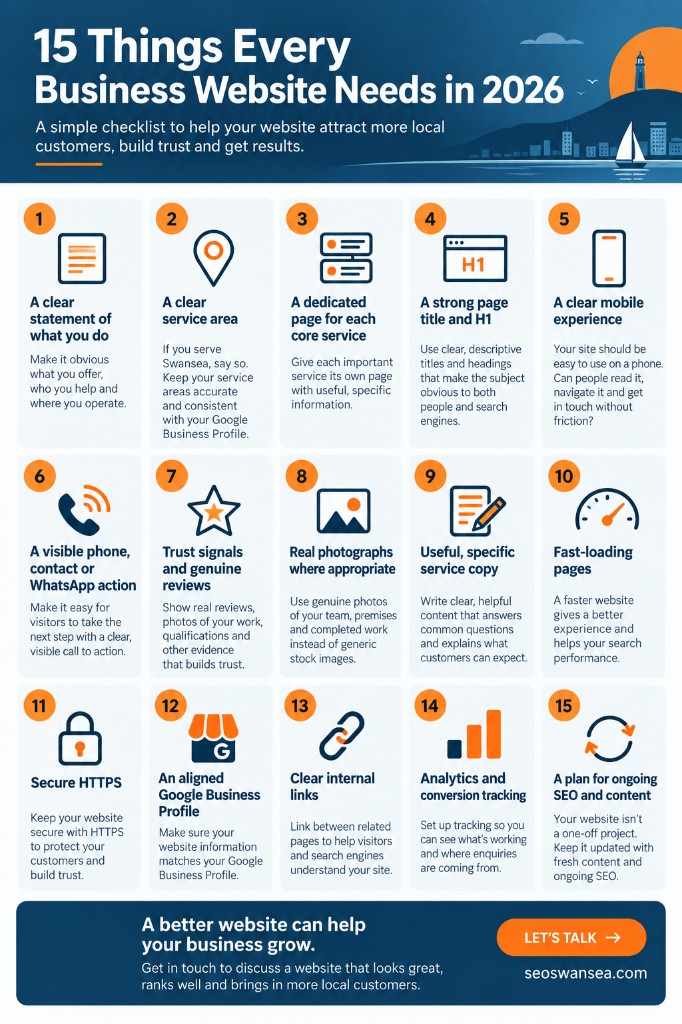
The quick checklist
Your Swansea business website should have:
1. A clear statement of what you do
A visitor should understand your business within a few seconds.
Your homepage should make three things obvious:
- What you offer
- Who you help
- Where you operate
“Quality you can trust” is not enough information.
“Electrician in Swansea, covering Mumbles and Gower” is much clearer.
2. A clear service area
If you serve Swansea, say so.
Only mention areas you genuinely serve. Don't create pages for dozens of towns simply to add location keywords.
Your website should also match the information on your Google Business Profile. Google says complete and accurate Business Profile information helps businesses appear in relevant local searches, and local results are primarily influenced by relevance, distance and prominence (Google Business Profile help).
3. A dedicated page for each core service
If you offer several important services, don't squeeze everything onto one “Services” page.
A Swansea plumber might have:
- Boiler repairs
- Emergency plumbing
- Bathroom installations
- Leak detection
Someone searching for “boiler repair Swansea” should be able to land on a page specifically about boiler repairs.
A useful service page should explain the service, who it is for, the areas covered, what the process involves and how to get started.
This helps customers and gives search engines clearer information about the subjects your website covers — the same idea as the website SEO checklist and the local SEO and website design blueprint.
4. A strong page title and H1
Every important page should have a clear title that describes its subject.
For example:
The title helps describe the page in search results. The H1 is the main visible heading on the page.
Write them for humans first, while making the subject clear.
If your page is about bathroom installations in Swansea, the title and main heading should make that obvious.
5. A clear mobile experience
Open your website on your phone.
Now try to use it as a customer would.
Can you:
- Read the main information without zooming?
- Open the menu easily?
- Tap your phone number?
- Complete the contact form?
- See the important information without excessive scrolling?
- Book or request a quote?
Google uses mobile-first indexing, so your mobile experience also matters from a search perspective.
If the site is awkward to use, you are creating friction at exactly the point where someone is deciding whether to contact you.
6. A visible phone, contact or WhatsApp action
Don't make visitors search for your contact details.
Put the most useful action where people can see it.
Depending on your business, that might be:
- Call us
- Request a quote
- WhatsApp us
- Book an appointment
- Check availability
- Visit us
You don't need five competing buttons.
Choose the action that makes sense for the customer and make it easy to take. The same principle shows up in more Google bookings without ads.
7. Trust signals and genuine reviews
People need a reason to trust a business before they contact it.
Useful trust signals include:
- Genuine customer reviews
- Testimonials
- Photos of completed work
- Qualifications
- Relevant accreditations
- Years of experience
- Case studies
- Clear contact details
- A real business address where appropriate
Don't invent testimonials or fill the site with meaningless badges.
For a roofer, photographs of real work may be more persuasive than a paragraph about being “committed to excellence”.
For a tutor, qualifications and experience may matter more.
Use evidence that relates to the customer's decision. For the reputation side, see Google reviews for Swansea businesses.
8. Real photographs where appropriate
Stock photography can make a small-business website feel generic.
Where possible, show the actual business.
That might mean:
- Your team
- Your premises
- Your vehicles
- Completed projects
- Products
- Before-and-after photographs
- The people customers will actually deal with
A well-lit, relevant photograph taken with a modern phone can be more useful than a generic stock image.
Make sure large images are properly sized and compressed so they don't unnecessarily slow the site down.
9. Useful, specific service copy
Your service pages should answer the questions customers actually have.
For example:
- What does the service include?
- Who is it suitable for?
- Where do you provide it?
- How does the process work?
- How long does it usually take?
- Do you offer quotes?
- What happens after I enquire?
- What makes your approach different?
Avoid writing pages that say little more than “We provide a professional, reliable and high-quality service.”
Tell the reader something useful.
Specific copy also gives you more opportunities to naturally address the subjects and phrases that matter to your customers.
10. Fast-loading pages
A slow website creates friction.
Check your pages on both desktop and mobile. Look at large images, unnecessary scripts, plugins and other elements that may be making pages heavier than they need to be.
Google provides PageSpeed Insights for testing page performance.
You don't need to obsess over a perfect score. Focus on problems that affect real users and important pages.
For a local business, your homepage, service pages and contact journey should work reliably and quickly.
11. Secure HTTPS
Your website should use HTTPS rather than an unsecured HTTP connection.
Look at the address bar. Your site should load using https://.
HTTPS encrypts information exchanged between the browser and website. It is particularly important if customers submit forms, create accounts or provide other information.
Your hosting provider or website developer should be able to configure and maintain the SSL/TLS certificate required for HTTPS.
This is a basic technical requirement for a modern website, not an optional extra.
12. An aligned Google Business Profile
Your website and Google Business Profile should support the same business information.
Check:
- Business name
- Address
- Phone number
- Website
- Opening hours
- Services
- Business category
- Photos
- Reviews
Google says it uses information from Business Profiles and other sources, including websites, to help provide local search results (how Google uses business information).
Keeping the profile accurate also gives customers useful information before they ever reach your website.
If your website says one thing and your Business Profile says another, fix the inconsistency. Start with local SEO basics for Swansea if you need the wider picture.
13. Clear internal links
Don't make every page a dead end.
Link related pages together so customers can move naturally through your website.
For example, a bathroom installation page might link to:
- Your plumbing services
- Bathroom project examples
- Your contact page
A blog post about boiler problems might link to your boiler repair service.
Use descriptive anchor text where it makes sense.
“Read more” tells the reader very little. “See our boiler repair service” is clearer.
Internal links also help search engines discover and understand relationships between pages.
14. Analytics and conversion tracking
You need to know what happens after someone arrives.
At a basic level, you should be able to understand:
- Which pages people visit
- Where visitors come from
- Which pages generate engagement
- Whether people submit your enquiry form
- Whether people click your phone number or other important actions
Google Analytics can measure interactions as events. Important actions can then be marked as key events so you can evaluate business performance. Google specifically lists generate_lead as a recommended event for measuring lead-generation activity (key events in Google Analytics).
For a local business, tracking a form submission or quote request is much more useful than simply knowing that somebody viewed the homepage.
15. A plan for ongoing SEO and content
Launching a website isn't the end of the job.
Your business changes. Your services change. Competitors publish new content. Customers ask new questions.
Your website should have a plan for staying useful and visible.
That might include:
- Monitoring important search terms
- Improving existing service pages
- Adding genuinely useful guides
- Updating outdated information
- Maintaining your Google Business Profile
- Building relevant local authority
- Checking technical issues
- Reviewing enquiries and conversion data
You don't need to publish three blog posts every week. For many local businesses, improving pages that directly support important services is a better starting point.
The aim is ongoing improvement, not content for content's sake. If you need help keeping that going, local SEO Swansea starts from £145/month for businesses that already manage their own website.
How does your Swansea business website score?
Give yourself one point for every item you can confidently answer “yes” to.
This score isn't a Google ranking score. It is simply a practical way to decide where to start.
A low score doesn't automatically mean you need a new website. You may be able to improve the existing one.
If the site is difficult to edit, isn't mobile-friendly, has a poor structure or was never built with search and conversions in mind, a rebuild may make more sense.
Does your website need fixing or replacing?
A website doesn't have to be complicated to work well.
It needs to tell people what you do, make your services easy to understand, help local customers find you and give them a clear way to take the next step.
If you're considering a new website, the approach at SEO Swansea is to build the website and local SEO together rather than treating them as separate jobs.
The £195/month website and SEO package includes a new 3–5 page website, hosting, maintenance, support and local SEO, with no upfront build fee. It is designed for smaller local businesses in Swansea and the surrounding area, rather than large e-commerce or complex websites. See current pricing for the full picture.
If your existing website is fundamentally sound, you may not need a new one — local SEO starts from £145/month for businesses that already have a website they manage.
Frequently asked questions
What should a small business website include?
At minimum, it should clearly explain what you do, who you serve, where you operate, what services you offer and how customers can contact you. It should also work well on mobile, use HTTPS, connect sensibly with your Google Business Profile and have basic analytics and SEO foundations.
How many pages should a small business website have?
There is no universal number. The site should have enough pages to explain your important services properly. If you have five distinct core services, five separate service pages may be more useful than putting them all on one page.
Does every business need a blog?
No. A blog can be useful when you have genuinely useful topics to cover, but a local business may get more value from improving its core service pages first.
Does a website need SEO from day one?
If you want people to find the website through search, it makes sense to consider SEO when the site is being planned. Site structure, page topics, titles, internal links and service pages are easier to get right before launch than after a website has already been built around the wrong structure.
What is the most important thing on a business website?
There isn't one element that matters in isolation. Start with clarity: visitors need to understand what you do, whether you can help them and what they should do next.
Sources and useful resources
- Google Business Profile: improve your local ranking — official guidance on local search and Business Profiles
- Google Business Profile: how Google uses business information — official guidance on local listings and website information
- Google Analytics: measuring key events and conversions — official analytics guidance
- Website Design Swansea — website design and local SEO together
- Website + SEO package — £195/month package details
- Pricing — current website and local SEO pricing